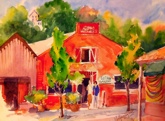

What is a Giclée?
The term “giclée” (pronounced zhee-clay) was coined in 1991 and refers to the product of an ink spray (gicléer, in French) printing process. The word is currently used to distinguish “fine art prints (reproductions)” from other commercial reproduction processes. In the past it has also been referred to as an “Iris” print due to the fact that this was the brand name of one of the first high-end digital printers. Now that there are newer and superior printer, media and ink technologies available, this term is no longer used synonymously with giclée.
A giclée reproduction begins with a high-resolution digital file of the original artwork. Using computer software and collaborating directly with the artist, the digital image is adjusted to insure that the color balance, detail and tonality match the original as closely as possible. Finally the giclée reproduction is prepared directly from the digital file using a state-of-the-art, large format inkjet printer. Reproductions can be prepared in any number, on a variety of media and in almost any size. This process, different from traditional offset lithography or serigraphy, gives a much more precise and “truer to the original” look. Displaying a full-color spectrum, giclée reproductions capture every nuance of a piece of art – whatever the original media.
Using the latest inkjet technology, the finest museum quality inkjet compatible media, and archival, pigmented inks insures that each giclée reproduction, if properly displayed, should last upwards of 100 years without discernable fading and color shift (possibly a greater lifespan than the original work of art).
Note that the word “print” is often used interchangeably with “reproduction” in
this context. However, a true print is an original art piece created from
an etching plate, photographic negative, linoleum block, etc. where each
version of the print is individually created by the artist. A different
process altogether.